

By H.Y2026.06.29 Update
How to Move Through an Art Fair: Reading the Room, Finding the Work
An art fair is neither a museum nor a gallery show. It's a temporary city of booths — galleries from across the world, each presenting the artists they believe in, for a few days only. The density is unlike anything else: hundreds of works, dozens of galleries, a market in motion.
If a museum is where work that's already been validated by history comes to rest, a fair is where the conversation about value is still ongoing. Prices are visible (or available on request). Collectors are making decisions in real time. Gallery staff are present and talking. The atmosphere is its own thing — and learning to read it is part of what makes a fair worth attending. This article is about how to do that.
1. What an Art Fair Actually Is — and How It Differs from a Museum
An art fair is an event where multiple galleries set up individual booths to exhibit and sell works by the artists they represent. Unlike a museum show — which exists primarily for public appreciation — a fair is explicitly commercial. Collectors, curators, museum professionals, and general visitors all circulate through the same space. Artists are sometimes present.
At the international level, Art Basel (Basel, Hong Kong, Paris), Frieze (London, New York, Seoul), and TEFAF are the major fixtures. In Japan, Art Fair Tokyo (held each March at Tokyo International Forum, now in its 20th edition) and Tokyo Gendai (launched in 2023, held each autumn at Pacifico Yokohama) have established themselves as the two most prominent events, with Art Collaboration Kyoto (ACK) rounding out the main calendar.
The key difference from a museum: works have prices attached, and in some cases you can take something home that day. But this doesn't mean you're obligated to. "The essence of a fair is to provide a space for choosing from among diverse things — a kind of frontier map of different genres," in the words of Art Fair Tokyo's Managing Director. You can engage with a fair entirely on your own terms.
2. Before You Arrive
Fairs can run to hundreds of booths. Walking in without any preparation, you can lose your bearings within the first half-hour. The point of doing homework isn't to avoid getting lost — it's to give yourself a few anchors before you arrive.
Almost every fair publishes its exhibitor list and floor plan in advance, often through a dedicated app or website. Spend a few minutes beforehand scanning the galleries, noting any artists whose work you already know or whose names keep appearing in shows you've liked. On the day, head toward those booths first, then let the surrounding area pull you in. That rhythm — target, then drift — tends to produce better visits than trying to be systematic.
Platforms like Artsy often let you browse booth previews before the fair opens. Worth checking, with the caveat that final booth presentations sometimes differ from what's listed online. Treat advance research as orientation, not a checklist.
3. How to Move Through the Space
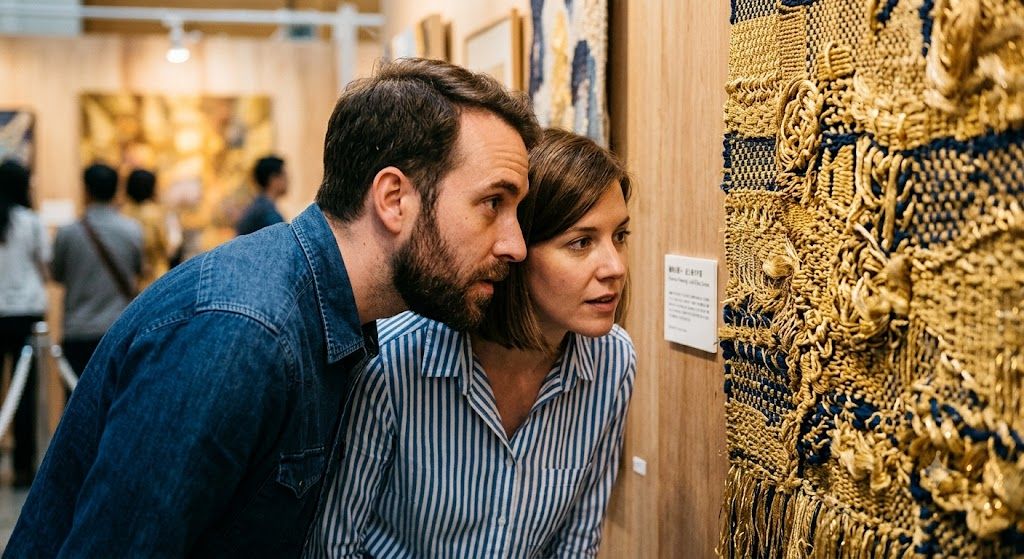
On arrival, resist the urge to slow down immediately. Do a loose first pass of the whole fair — not stopping to study anything, just noting on the map which booths caught your attention. It takes maybe twenty minutes, and when it's done you'll have a rough sense of where your instincts are pointing.
Then go back to what you flagged. That return visit, when you're no longer just orienting, is usually where the real looking happens.
Fairs that organize by section reward a slightly different approach. Tokyo Gendai, for instance, divides its booths into "Galleries" (established names), "Hana" (younger and mid-career artists), and "Eda" (artists with roots in Asia) — meaning you can weight your time according to what you're actually curious about. Art Fair Tokyo spans everything from classical antiques and craft to contemporary work, which makes it useful for discovering what genres you respond to.
If you get tired, stop. A coffee and fifteen minutes sitting down will reset your eyes. Returning after a break, you often notice things that didn't register the first time.
4. Talking to Galleries
The people standing in the booths are gallery staff — sometimes the gallerist themselves, sometimes the artist. Many first-time visitors hesitate to approach them. There's no need to.
"Can you tell me more about this work?" or "Does this artist have other pieces I could see?" is all it takes to open a conversation. From there, galleries will often offer an artist's CV, show you portfolio images, or mention works that didn't make it into the booth. What's on display is always a selection; there's more behind it.
Many booths don't display prices. Asking for a price doesn't commit you to anything — it's normal and expected. You won't be pressured. If a work is beyond your budget, just say so; the conversation can continue from there, or it doesn't have to.
5. Red Dots — and What It Means to Buy at a Fair
You'll notice small red stickers appearing next to works as the day progresses. A red dot means the work has sold. If a piece you're drawn to already has a dot, it's worth asking the gallery anyway — they may have a similar work, a different edition, or another piece by the same artist available.
If you're considering a purchase, two things are useful to decide in advance: the maximum size you can realistically take home, and a rough sense of your budget range. The atmosphere on a fair floor has a way of compressing decision-making. If you're uncertain, leave the booth, walk around for a while, and come back. If the work is still pulling at you when you return, that's real interest.
Alain Servais, a Brussels-based collector who has attended over a thousand art fairs, put it plainly: the worst mistake a new collector can make is walking into a fair with the goal of walking out with something (Artsy, 2017). A fair is a place for looking and learning first. Buying, when it happens, tends to be a natural extension of that — not the other way around.
6. Beyond the Booths
During a fair's run, programming typically extends well beyond the exhibition floor. Tokyo Gendai coincides with TENNOZ ART WEEK, which activates galleries and cultural venues across the Tennoz waterfront area. Art Fair Tokyo draws gallery openings in the Roppongi and Ginza neighborhoods. Some fairs offer discounted or complimentary entry to nearby museums for ticket holders.
Inside most fairs, there are also talk programs — conversations with artists, curators, collectors, or critics that provide context you won't find by walking the booths alone. These are often free to attend with fair admission, and some require advance registration. Check the fair's program calendar before you go.
7. The Main Art Fairs in Japan
Each fair has its own character. Knowing what they're each about makes it easier to choose where to start.
Art Fair Tokyo (Tokyo International Forum, every March): Japan's largest fair by scale, with a wide range covering classical antiques, craft, photography, and contemporary art. Good for understanding the full breadth of the Japanese art market. 2026 marks the 20th edition.
Tokyo Gendai (Pacifico Yokohama, every autumn): Contemporary-focused and internationally oriented, with strong participation from galleries like Pace and Sadie Coles HQ. Organized into clear sections, which makes navigation easier for first-timers.
Art Collaboration Kyoto (ACK) (Kyoto, every autumn): Structured around collaborations between domestic and international galleries. The Kyoto setting gives it a particular texture, and the programming tends to reflect it.
KOGEI Art Fair Kanazawa (Kanazawa, every autumn): One of the only fairs in Japan dedicated to craft — lacquer, ceramics, textile — in a city with deep roots in that tradition.
One last thing: an art fair is worth attending as an event in itself — a particular kind of concentration that only exists for a few days each year. The same space won't exist again. Whether you're there to look, to talk, or simply to absorb the atmosphere, even a single work that stays with you afterward is reason enough to go.

