

By H.Y2026.05.25 Update
Editorial note: This article is intended for general informational purposes regarding inheritance tax. For advice on specific situations, please consult a qualified tax accountant, attorney, or other professional.
Introduction
In November and December 2024, Fuji Television's documentary series The Nonfiction shone a spotlight on the inheritance of art — and sparked a wave of public reaction.
Yosuke Guifré Ochiai (44), a television director, lost his father Kōji Ochiai to a sudden fire in April 2024. Kōji had been a celebrated painter who, in the 1980s, was named among the "150 Contemporary Artists of Spain" alongside Picasso and Miró. What he left behind was approximately 1,000 paintings in his atelier — and roughly ¥15 million in debt. Under Japan's inheritance laws, the choice was stark: accept the paintings and inherit the debt, or renounce the estate and lose the artwork entirely. Was his father's work worthless — or a treasure the world had yet to rediscover? For many viewers, this story was the first time the reality of inheriting art had ever felt truly personal.
(Source: Yahoo! News / Fuji TV Documentary, "Inherit or Renounce: 1,000 Paintings and ¥15 Million in Debt Left by a Father Who Sacrificed His Family," December 2024)
This case may seem extraordinary, but the underlying challenge is not uncommon. When paintings, ceramics, or antiques passed down by a parent or grandparent suddenly become your responsibility, most people's first questions are the same: What do I need to do? How much tax will I owe?
Unlike cash or real estate, the value of artwork is difficult to assess at a glance, and the rules for valuation are highly specific. Making things more urgent: the deadline to file and pay inheritance tax is within ten months of the date of the decedent's death — with virtually no extensions granted. Understanding the process early is essential.
This article walks through the full inheritance procedure for art and collectibles in Japan — covering valuation methods, the filing timeline, available tax relief measures, and key pitfalls to avoid — with references to the relevant laws and regulations throughout.
1. Art Is Subject to Inheritance Tax
First, the baseline: all artworks — paintings, sculpture, ceramics, antiques, and decorative objects — are counted as inherited assets and subject to inheritance tax in Japan.
Article 22 of the Inheritance Tax Act states that inherited assets must be valued at their fair market value at the time of acquisition (Source: National Tax Agency, Tax Answer No. 4622). Assuming that "it's just an old antique" or "I didn't pay much for it" and failing to report it can result in penalties including a non-filing surcharge, delinquency tax, and in serious cases, a heavy additional tax for fraudulent concealment.
Works of art — valuable assets whose worth is not immediately apparent — are known to be used in tax avoidance schemes, and tax authorities scrutinize them closely. (Source: Landmark Tax Accountant Corporation, "Is Inheritance Tax Levied on Artwork?")
Reference: Penalty Overview for Underfiling or Non-Filing
- Non-filing surcharge: 15–20% of tax owed (reduced to 5% if voluntarily filed before an audit commences)
- Underfiling surcharge: 10% of the additional tax owed
- Heavy additional tax: 35–40% if fraud or willful concealment is determined
- Delinquency tax: Accrues on a daily basis from the filing deadline until the tax is paid in full
(Source: Saison Card, "What to Know If Your Inherited Estate Includes Art or Antiques")
2. Start by Taking Stock of What You Have
Artsy, the international art marketplace, opens its practical guide "What to Do If You Inherit an Art Collection" with a simple but essential first principle:
"Before figuring out what you're going to do, first assess what you have." (Source: Artsy, "What to Do If You Inherit an Art Collection")
Artsy also cautions that even when a collection inventory already exists, valuations must be brought up to date for tax purposes — a prior appraisal cannot simply be reused. They further recommend obtaining an equitable distribution appraisal when a collection is to be divided among multiple heirs, which maps closely to Japan's concept of the seitsūsha iken kakaku (specialist opinion valuation) described below.
3. How Inherited Artwork Is Valued for Tax Purposes
The Governing Rule: Property Valuation Basic Circular, Article 135
The valuation of artwork for Japanese inheritance tax purposes is governed by Article 135 of the National Tax Agency's Property Valuation Basic Circular (書画骨とう品の評価 — "Valuation of Paintings, Calligraphy, and Antiques").
- ① Artwork held by dealers (antique dealers, art traders, etc.) → Valued as inventory, based on book value
- ② Artwork held by private individuals (the most common case) → Valued by reference to comparable market transaction prices and specialist opinion valuations
(Source: NTA Property Valuation Basic Circular, Article 135; Chester Tax Accountant Corporation)
For most families, category ② applies. Here is how each method works in practice.
Method ①: Comparable Market Transaction Price
The comparable market transaction price (baibai jitsurei kakaku) is the price at which similar works have actually changed hands in the open market. It is derived from auction results, dealer prices, or historical sales records for comparable pieces.
This approach works best for works that exist in multiples or have an established secondary market. Useful reference points include:
- Hammer prices from online auction platforms (Yahoo Auctions, Christie's, etc.)
- Estimates or offers from buyback dealers
- Original purchase contracts or receipts
However, most artworks are one-of-a-kind, making true comparables difficult to find. Relying solely on this method may invite questions from the tax office about how the figure was determined.
(Source: Geihinkан; Atom Law Office, "How Is Inheritance Tax Calculated for Antiques and Artworks?")
Method ②: Specialist Opinion Valuation (Recommended)
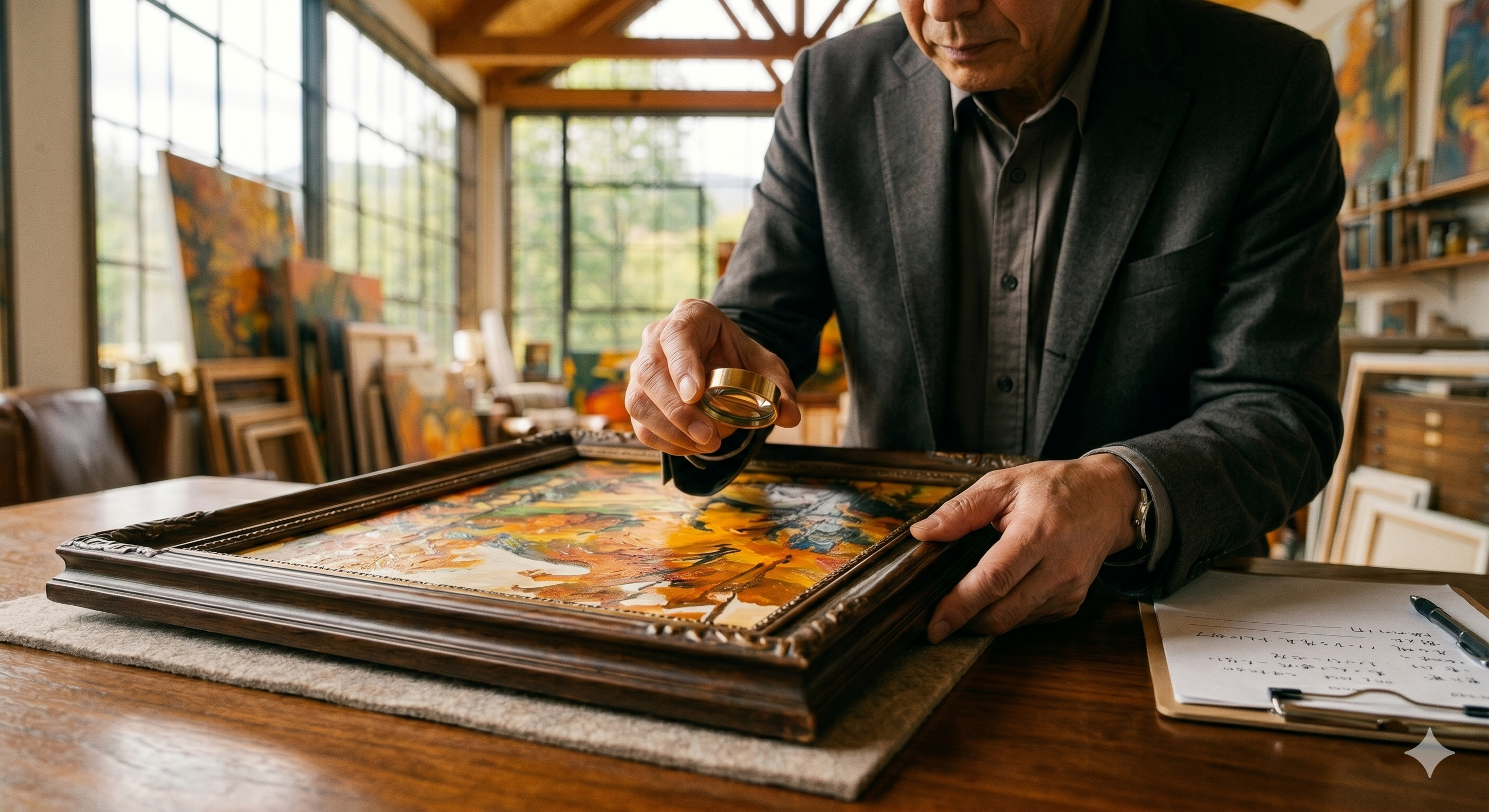
The specialist opinion valuation (seitsūsha iken kakaku) is an assessed value produced by a qualified expert — an antique dealer, certified art appraiser, or specialist in the relevant field — based on what the work would realistically fetch in a genuine transaction.
Because tax authorities require clear, substantiated bases for the figures in an inheritance filing, obtaining a formal appraisal report from a recognized specialist is considered the most reliable approach, and the most effective way to reduce the risk of a tax audit.
The most objective and persuasive valuation is one provided by a specialist in the artwork in question. An expert — an art dealer or appraiser — can assess not just authenticity but artistic value with far greater precision than any other method. (Source: Landmark Tax Accountant Corporation)
Important: Appraisal fees are not deductible from inheritance tax. These costs are borne entirely by the heirs — but they are best understood as the price of reduced audit risk. For any artwork whose value is uncertain, engaging a specialist is worth serious consideration.
(Source: Atom Law Office; Green Judicial Scrivener Corporation)
Practical Framework by Estimated Value
- Under ¥500,000: The work may be grouped under general household effects. A free estimate from a resale shop can serve as a reasonable reference value.
- ¥500,000 – ¥3,000,000: Obtain estimates from buyback dealers or auction houses and use the comparable market transaction price as the basis for valuation.
- ¥3,000,000 and above: Commission a formal specialist opinion valuation (appraisal report) from a qualified antique dealer or certified art appraiser before filing.
(Source: Yokohama Inheritance Tax Consultation Window; OAG Tax Accountant Corporation)
4. The Full Inheritance Timeline (10-Month Schedule)
The deadline to file and pay inheritance tax is within ten months of the day following the decedent's death (Inheritance Tax Act, Article 27). Extensions are not available as a rule. Artwork valuation, estate division, and tax filing must all be completed within this window.
Phase-by-Phase Breakdown
[Months 1–3: Groundwork Phase]
- Locate and verify the will; initiate probate if needed (notarized wills and wills registered with the Legal Affairs Bureau do not require probate)
- Confirm all legal heirs (collect family registry documents)
- Consider renouncing the inheritance if applicable (must be filed within 3 months)
- Inventory all assets and liabilities, including artworks
[Months 3–7: Valuation & Negotiation Phase]
- Conduct preliminary research on artwork values (auction sites, buyback dealers)
- Commission specialist appraisals for high-value works
- Hold estate division discussions (requires agreement from all heirs)
- Prepare and execute the estate division agreement
[Months 7–10: Filing & Payment Phase]
- Calculate inheritance tax and prepare the tax return (engaging a tax accountant is strongly recommended)
- Submit the return to the tax office with jurisdiction over the decedent's address
- Pay the inheritance tax (lump-sum cash payment is the default)
(Source: Nomura Securities, "Inheritance Procedure Schedule"; OAG Tax Accountant Corporation)
Dividing Artwork Among Heirs
Because artworks are movable property, shared co-ownership among multiple heirs is generally impractical (storage and use become unworkable). The three main approaches to division are:
- Distribution in kind: One heir receives the artwork; other assets are adjusted to compensate
- Sale and distribution: The artwork is sold, and the proceeds are divided in proportion to each heir's share
- Compensatory distribution: One heir takes the artwork and pays monetary compensation to the others
(Source: Hiroshima Best Law Office)
5. The Inheritance Tax Deferral and Exemption for Designated Artworks
For artworks of significant artistic or cultural value, a special provision allows deferral of up to 80% of the applicable inheritance tax (Special Taxation Measures Act, Article 70-6-7, introduced in the 2018 tax reform).
How the Provision Works
When a decedent had, during their lifetime, entrusted a designated artwork to a qualifying museum under an approved conservation and utilization plan — and the heir continues that arrangement — the inheritance tax corresponding to 80% of the taxable value of that artwork is deferred.
The deferred tax is permanently waived if:
- The inheriting trustor dies
- The designated artwork is donated to the museum where it is held
- The designated artwork is lost or destroyed in a natural disaster
(Source: NTA Tax Answer No. 4154)
Eligibility Requirements
Two categories of artwork qualify for this provision. The first covers works designated as Important Cultural Properties under Article 27 of the Law for the Protection of Cultural Properties — including paintings, sculpture, and craft objects. The second covers Registered Tangible Cultural Properties under Article 58 of the same law, specifically those recognized as being of outstanding historical, artistic, or academic significance from the perspective of world culture.
The receiving institution must be a museum as defined under Article 2(1) of the Museum Act, or a designated facility engaged in the public display and preservation of artworks.
(Source: NTA Tax Answer No. 4154)
Ongoing Reporting Obligation
To maintain the deferral, heirs must submit a continuation report to the tax office every three years following the filing deadline. Failure to file terminates the deferral, triggering immediate payment of all deferred tax plus accrued interest.
(Source: NTA Pamphlet)
6. Planning Ahead: What You Can Do During Your Lifetime
For those who own artwork, taking proactive steps before an inheritance event occurs is far preferable to scrambling afterward.
Strategy ①: Know the Current Value of What You Own
Inheritance tax is calculated based on fair market value at the time of death — not the original purchase price. A work bought for ¥200,000 may be appraised at ¥2,000,000 at death; conversely, a piece purchased at great expense may now be worth very little.
Commissioning an appraisal during your lifetime and keeping a record of assessed values makes the process dramatically smoother for your heirs.
(Source: OAG Tax Accountant Corporation)
Strategy ②: Lifetime Gifting
When the overall estate is large and inheritance tax is likely to be significant, transferring artworks as gifts during one's lifetime removes them from the taxable estate.
- Annual gift tax exclusion: Up to ¥1.1 million per recipient per year, tax-free
- Gift tax deferral system (sōzoku-ji seisan kazei seido): Up to ¥25 million can be gifted tax-free at the time of transfer (though the amount is added back to the estate at death, valued at the time of the gift)
Note: Gifts made within seven years of death are subject to a clawback rule (effective from the 2024 tax reform, being phased in) and are added back to the taxable estate. Early and deliberate planning is essential.
(Source: Atom Law Office)
Strategy ③: Selling During Your Lifetime
Selling artwork while alive and converting it to cash simplifies the estate considerably — heirs divide liquid assets rather than debating what to do with physical objects.
Bear in mind that profits from the sale (the amount by which the sale price exceeds the purchase price) are subject to income tax as capital gains. After applying the special deduction (up to ¥500,000), model the tax impact before deciding.
(Source: Landmark Tax Accountant Corporation)
Strategy ④: Depositing Works with a Museum
For particularly valuable works, placing them on deposit with a qualifying museum under the Museum Act — and meeting the requirements for the deferral provision described above — is a meaningful option. Note that this requires the preparation of an approved conservation and utilization plan in advance.
(Source: Agency for Cultural Affairs)
7. What to Know About Tax Audits
Artworks and antiques are among the assets that tax authorities scrutinize most carefully — precisely because their value is not immediately apparent.
The NTA's own operational guidelines explicitly state that when valuing artworks, if "the value of the asset is enhanced by the existence of an appraisal or equivalent certification, an appraiser should be engaged."
Situations that raise audit risk:
- High-value works reported as part of a generic "household effects" lump sum
- Valuations based solely on comparable market prices, with no appraisal report
- A significant gap between the declared value and the price actually received upon sale
- An estate belonging to a known collector, but with reported artwork values that seem unexpectedly low
Tax authorities can and do review the decedent's financial transaction history and purchase records. Assuming something will "slip through" is a serious miscalculation.
(Source: Saison Card; Atom Law Office)
Column: What the Guifré Story Tells Us
What made the story of Yosuke Guifré Ochiai resonate so deeply with viewers was not the tax question itself — it was the fact that inheritance, at its core, is inseparable from deeply human questions: how do we assess the value of a life's work? How do we reckon with the memory of someone we loved imperfectly?
To renounce the estate would erase the debt. But it would also mean giving up every one of the 1,000 paintings his father had spent his life creating. Did the people of Spain still see something in his father's work that Japan had long since stopped looking for? Guifré's six-month journey to find out is a reminder that inheriting art always involves a kind of value judgment that no tax form can capture.
At the same time, acting on emotion alone carries real procedural and tax risk. A collection of 1,000 paintings by a once-celebrated artist is precisely the kind of estate that tax authorities are likely to examine closely. Whether you are leaving art behind or receiving it, organizing a clear record of your collection's value during your lifetime may be the most considerate thing you can do for the people who will come after you.
(Source: MyNavi News, "The Father Who Died in Flames Came Alive Inside Me — Yosuke Guifré Ochiai," November 2024 / Yahoo! News, Fuji TV Documentary, December 2024)
Summary: Art Inheritance Checklist
- Confirm whether any artworks or antiques are included in the inherited estate
- Research approximate values for unknown works via auction sites or buyback dealers
- For works potentially worth ¥millions or more, commission a formal specialist opinion valuation (appraisal report)
- Determine through estate division discussions how artworks will be handled (distribution in kind, sale, or compensatory payment)
- Complete the inheritance tax filing and payment within 10 months of the date of death
- For Important Cultural Properties or Registered Tangible Cultural Properties, explore the inheritance tax deferral provision
- If you currently own artwork, have it appraised and begin planning early
Inheriting art is fundamentally different from inheriting financial assets. It demands specialized knowledge across valuation, estate division, and tax law simultaneously. Engaging the right professionals — a tax accountant, an attorney, and a qualified art appraiser — as early as possible is the single most effective thing you can do to ensure a smooth process and minimize tax risk.

