

Artist Feature : Art Basel Hong Kong 2023
FeaturesBy Ryusei2023.10.10 Update
In March 2023, Art Basel Hong Kong returned with its full capacity.
For almost three years, not only Art Basel but the entire art industry had been severely affected by Covid-19, a crisis of unprecedented scale, it would be no exaggeration to say this.
However, this year's Art Basel was a whole city event that seemed to have regained its momentum, with all the special exhibitions at museums, including M+, and reception parties at galleries based in the city. During the pandemic, many art fairs and gallery exhibitions, including Art Basel, approached collectors through online viewing rooms, but this time, I felt the great importance of actually holding an art fair and seeing the works themselves with my own eyes. It must not have been an easy few years for the participating galleries, but their presentations, from museum-scale installations to booths dedicated to up-and-coming artists, were all vividly “alive".
In this article, I’d like to present two of the most memorable presentations.
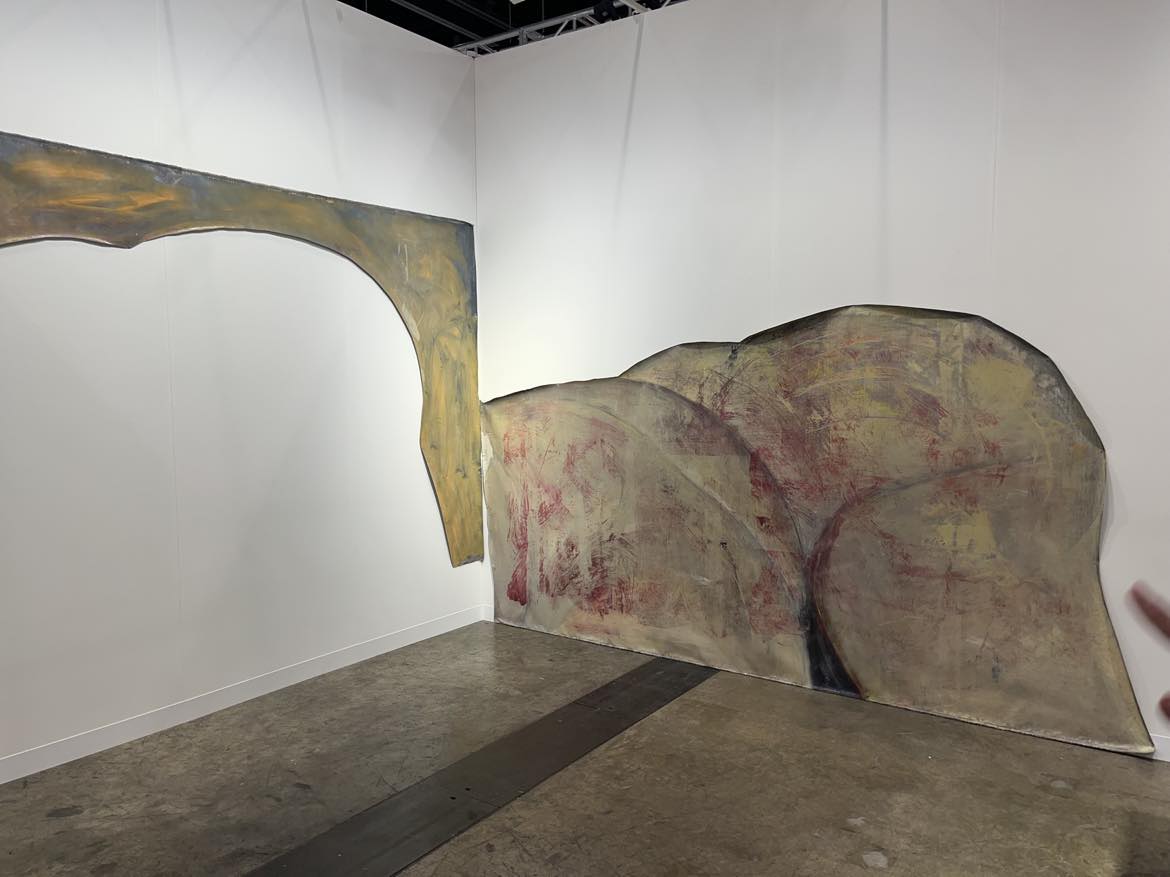
Ser Serpas' installation was exhibited by Paris-based Balice Hertling at this year's Hong Kong Basel. The installation was a large, hollowed-out canvas painted in sensual and somewhat melancholic tones. The bold composition of course, but what caught my attention was the depth of the artist's layers and his use of "red. The red color used by the artist added accent to the somewhat melancholic background color and seemed to draw out the sensuality of the work.
Ser Serpas (b. 1995) works through a variety of mediums, including painting, sculpture, drawing, and poetry, with death and legacy as her main themes. Her work incorporates everyday objects as expressive mediums and draws on art historical context to bring multiple layers to her work. One of the characteristics of her work is the representation of the body, painted with strong, flesh-toned strokes. Her oil paintings go beyond mere portraits to convey the intricate feel and emotions of the body, and she incorporates personal elements such as photographs of lovers, friends, herself, and old cell phone images, treating them as found objects.
She is best known for her series of paintings in which she incorporates random objects found on the street, but in recent years she has also been creating boldly composed paintings on canvas based on photographs taken with her iphone. Her work is held in prominent collections such as the Pinault Collection, the Hammer Museum, and the Rubell Family Collection.
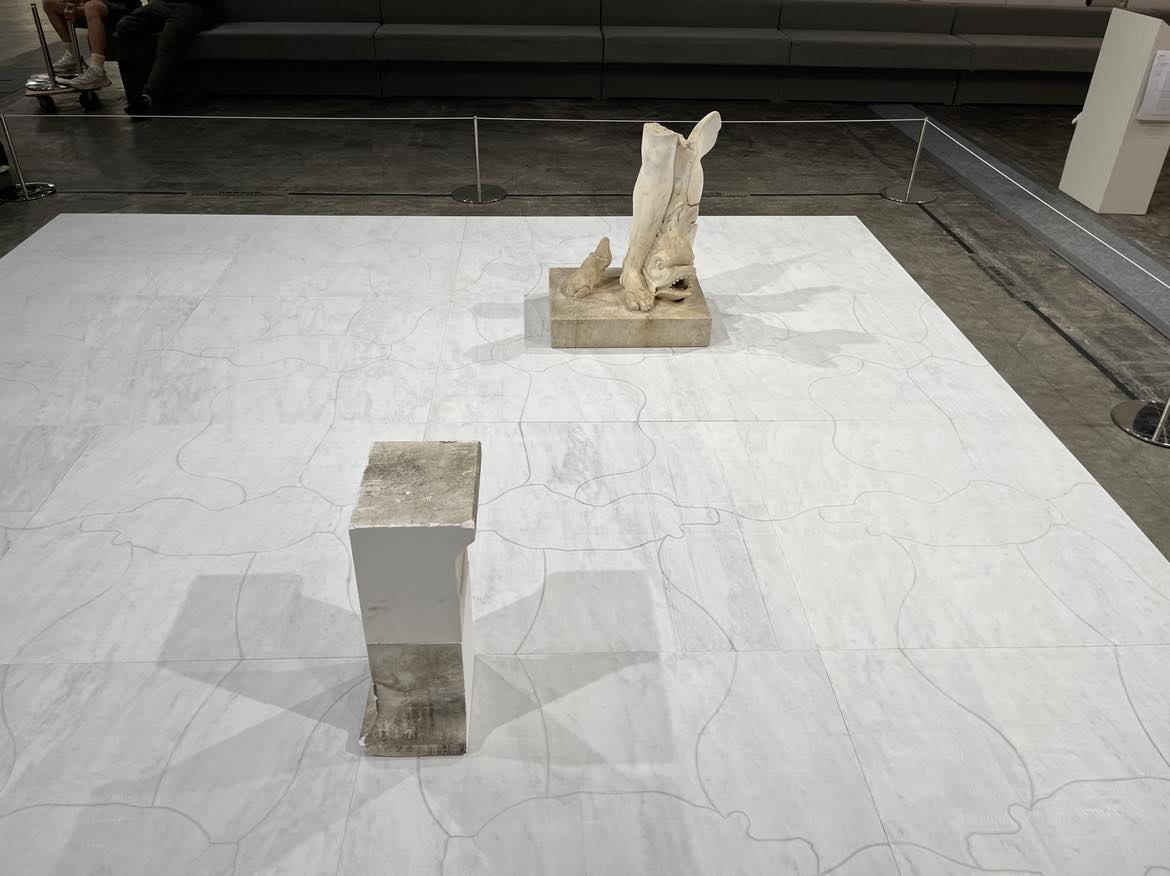
This work by Berlin-based artist Danh Vo was exhibited at Art Basel Hong Kong in the section called Encounter, which exhibits large-scale installations. Three sculptures are each placed on a white marble floor. In this work, Danh Vo's poetic approach and clever use of ready-made objects and their contextual references create the "symbol" that is one of the features of the artist's work.
By using ready-made wood sculptures and other objects, Danh Vo reinterprets objects imbued with personal and more universal longings and sorrows. By taking the objects out of their original environment, this work expresses how meaning and symbolism change based on the context and environment in which the chosen objects are placed. The minimalist arrangement of symbolism in this work also suggests the power structure behind our liberal society and the fragility of the concept of the nation itself.
Danh Vo (1975) was born in Vietnam, later immigrated to Denmark, and currently lives and works in Berlin and Mexico City.He has exhibited in museums worldwide, including the Guggenheim Museum and the Pinault Collection, and uses a variety of ready-made objects and materials to reinterpret the world through their symbolism, from personal feelings to political contexts.
Both artists use found objects, but each has his and her own way of drawing out narratives from them. In Danh Vo's work, political symbol is found in found objects and used to construct a world as a work of art, whereas in Ser Serpas' work, such strong political symbolism is not so apparent, which may be seen as a contrast.

